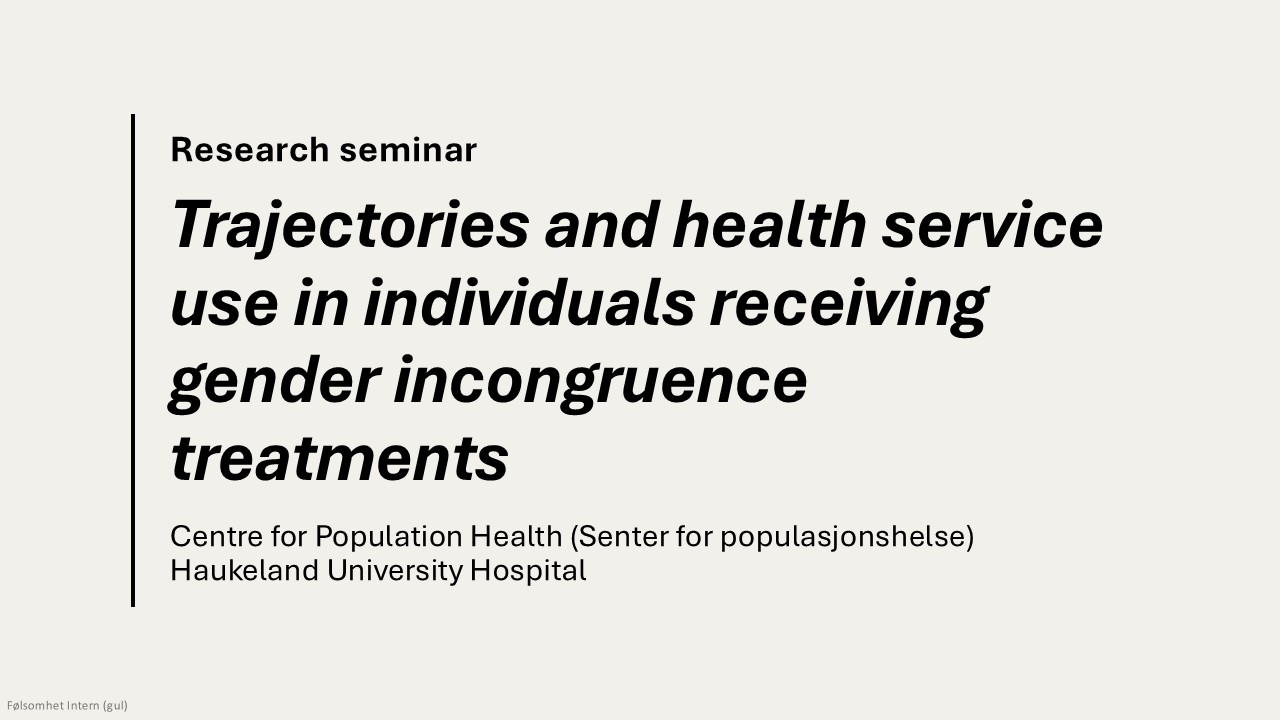
Seminar on the research project Trajectories and health service use in individuals receiving gender incongruence treatments
Tors.

04

.

06

17:00

20:00

Auditoriet Trond Mohn

Bli med
Kjøp billett
Billetter i døren
Gratis

Welcome


​About the project

The project is a registry-based study funded by Helse Vest, examining long-term outcomes and patterns of health service use in individuals who have received treatment for gender incongruence in Norway. By linking national health and population registries, the project aims to describe trajectories over time and to provide an empirical basis for further clinical and policy discussions. The study is conducted in collaboration with the four regional centres for gender incongruence (RSKi), the National Treatment Service for Gender Incongruence (NBTK) at Rikshospitalet, the Norwegian Institute of Public Health (FHI), and King's College London, together with user organisations.

​Purpose of the seminar The aim of the meeting is transparency in research. We also wish to contribute to user involvement (brukermedvirkning). A central ambition is that researchers, clinicians and user organisations align on the relevant research questions and methods before the results are known. To place the project in an international context, we have invited external researchers, including Dr Hilary Cass and Professor Eóin Killackey, who will contribute perspectives from work conducted abroad. This is not a general seminar on research into gender incongruence, but specific for this project.

​Programme

Welcome and context for the meeting

Professor Eóin Killackey: On different contributions to research – Lived, loved, laboured and learned perspectives (1705-1725)

Arnstein Mykletun: presentation of our project, including project description and variables, and the ambition to agree on research questions and methods before the results are known (1725-1745)

Dr Hilary Cass presents The Cass Review, which concluded that the evidence base for puberty blockers in gender-affirming treatment is weak. The review had immediate implications for clinical services in the United Kingdom, and similar evidence reviews followed in other countries (1745-1815)

PhD student and clinical psychologist Eirik Stangeland Håheim: after Cass, and what is an evidence hierarchy? (1815-1830)

​Short break

Professor Emily Simonoff (King's College London) presents the ongoing PATHWAYS trial on puberty blockers (https://www.kcl.ac.uk/research/pathways), and on the topic of how the present project may contribute to knowledge gaps (1830-1855)

Research coordinator and clinical psychologist Lise Gulli Brokjøb: examples of comparable registry-based studies (1855-1905)

Perspectives from those with lived and loved experience. We have invited PKI, HBRS and GENID. Prespectives also from clinicians working at RSKIs. (1905-1955, time will be shared between those who participate in the meeting)

Closing before 2000.

Arrangør:
Senter for populasjonshelse, Helse Bergen
Alder:
Litthus i ditthus

Tors.

4

.

06

17:00

20:00

Auditoriet Trond Mohn

Gratis
Billetter i døren
Bli med
Kjøp billett
Arrangør:
Senter for populasjonshelse, Helse Bergen
Alder:

Seminar on the research project Trajectories and health service use in individuals receiving gender incongruence treatments

Welcome


​About the project

The project is a registry-based study funded by Helse Vest, examining long-term outcomes and patterns of health service use in individuals who have received treatment for gender incongruence in Norway. By linking national health and population registries, the project aims to describe trajectories over time and to provide an empirical basis for further clinical and policy discussions. The study is conducted in collaboration with the four regional centres for gender incongruence (RSKi), the National Treatment Service for Gender Incongruence (NBTK) at Rikshospitalet, the Norwegian Institute of Public Health (FHI), and King's College London, together with user organisations.

​Purpose of the seminar The aim of the meeting is transparency in research. We also wish to contribute to user involvement (brukermedvirkning). A central ambition is that researchers, clinicians and user organisations align on the relevant research questions and methods before the results are known. To place the project in an international context, we have invited external researchers, including Dr Hilary Cass and Professor Eóin Killackey, who will contribute perspectives from work conducted abroad. This is not a general seminar on research into gender incongruence, but specific for this project.

​Programme

Welcome and context for the meeting

Professor Eóin Killackey: On different contributions to research – Lived, loved, laboured and learned perspectives (1705-1725)

Arnstein Mykletun: presentation of our project, including project description and variables, and the ambition to agree on research questions and methods before the results are known (1725-1745)

Dr Hilary Cass presents The Cass Review, which concluded that the evidence base for puberty blockers in gender-affirming treatment is weak. The review had immediate implications for clinical services in the United Kingdom, and similar evidence reviews followed in other countries (1745-1815)

PhD student and clinical psychologist Eirik Stangeland Håheim: after Cass, and what is an evidence hierarchy? (1815-1830)

​Short break

Professor Emily Simonoff (King's College London) presents the ongoing PATHWAYS trial on puberty blockers (https://www.kcl.ac.uk/research/pathways), and on the topic of how the present project may contribute to knowledge gaps (1830-1855)

Research coordinator and clinical psychologist Lise Gulli Brokjøb: examples of comparable registry-based studies (1855-1905)

Perspectives from those with lived and loved experience. We have invited PKI, HBRS and GENID. Prespectives also from clinicians working at RSKIs. (1905-1955, time will be shared between those who participate in the meeting)

Closing before 2000.

Ingenting funnet.

Få siste nytt fra Litteraturhuset i Bergen.

Meld deg på nyhetsbrev
Takk! Vi har sendt deg en e-post!
Oj! Noe gikk galt.